It’s not that the AI generated content isn’t good. It’s that often there is no effort behind it.
If you haven’t taken the time to invest in your perspective, then why should your audience invest their time to consume it?
I see it here and on many other outlets. The same overused phrases, sentence structure and opinions. What I am watching is what happens when AI produces output without humans behind it.
When an organization chooses to mass produce output with an AI and calls the result a campaign, they get something that looks like marketing from the outside and functions like average on the inside. And average, churned and processed at AI speed and volume, doesn’t stay average for long. It becomes the bare minimum.
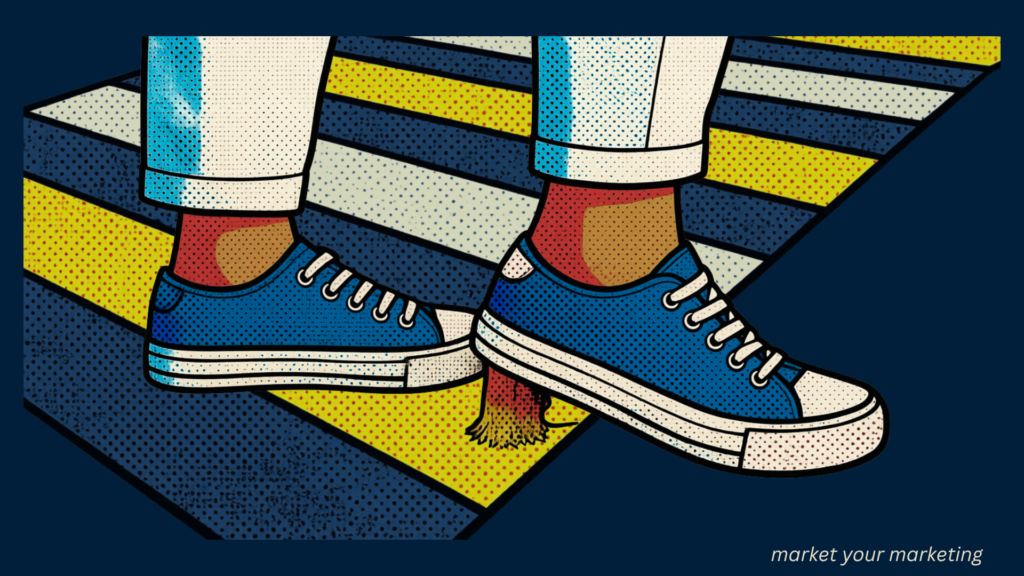
Think about what happens to gum on a sidewalk. Faded. Just the faint remnant of the flavor it once held. Hard to get off your shoe. Not something that’s going to make anyone excited.
What Faux Marketing actually costs
I watched a version of this play out with a team that handed their content calendar to AI. The output looked right: the right topics, the right posting cadence, the right tone on the surface. What it didn’t have was any of the institutional knowledge the marketer had spent two years building: which messages had already been tested and rejected, which audiences were fatigued, which product language the sales team was actively trying to retire. The AI had no way to know what it didn’t know. And nobody was in the loop long enough to catch it.
That’s Faux Marketing. It shows up looking like the real thing but is quietly chipping away at your credibility and success.
Now, I use AI. A lot. I’ve built custom projects and workflows that cut content research and gap analysis time by a third. But every single step of that process: I’m in it. Checking inputs. Refining prompts. Flagging when it’s ignoring an instruction. Using the output to spark ideas and push my thinking further than I’d get on my own. My job isn’t to follow the plan AI gives me. It’s to know that maybe 20% of that plan is usable, and to have the judgment to know which 20%.
That judgment is not something that can be replicated. It’s what makes marketing human.
What companies are revealing right now
Companies are revealing themselves. The ones choosing AI over skilled marketers fall into two groups: those who believe AI is good enough, and those who never really valued marketing in the first place. AI didn’t create the second group. It just gave them a new way to confirm what they already believed. You are watching organizations sort themselves in real time, and where they land tells you something important about whether your judgment will ever have a real home there.
Stop trying to prove your value to people who have already decided.
Think hard about that. Because the energy you’re spending trying to convince the unconvinced is energy you’re not spending on building visibility where it will land.
Which brings me to the sharper question: do you know how visible your judgment is right now? Your thinking, your reasoning, the decisions only you could have made. The real risk for skilled marketers is becoming invisible at a company that was never paying attention, and that’s a different problem than being replaced.
If you want to know where you stand, the Invisible Marketer Assessment is a good place to start. It takes about five minutes and tells you exactly how visible your judgment is inside your organization.
Take it here: ehumphries.com/invisible-marketer-assessment